

Work Flexibility Stigma: Where On Earth Does It Come From?
Lessons from Europe on why this might be about more than your workplace.

There is one word that comes up every time you speak to a mother who is trying to integrate motherhood and paid work. Any guesses?
Yep, you guessed it – flexibility! It always comes up. Flexible hours. Flexible location. Flexible role deliverables. Flexible leave.
Gwen Stefani needs a new song where she spells out F L E X I B I L I T Y, which, admittedly, doesn’t have the same ring as BANANAS, so you know, I won’t take up pop-songwriting any time soon.
Flexibility is a critical component of working mothers (of working parents), and yet, it persists as a contentious topic, both in how it is viewed and stigmatised culturally, and in how many workplaces (and the broader design of work) just can’t seem to get their shit together to make it a cold hard norm.
Now, I have previously written that I believe flexible work policies are a band-aid. As much as I am “pro flexible work”, I still stand by this view that it is a necessary band-aid over the problem that paid work (especially in the private sector) simply wasn’t designed for mothers. In the above article, I argued that one of the reasons flexible work is contentious is because it is often made informal and/or individualised, which is typically the antithesis of how workplaces run. Employee agreements and work formats are generally pretty standardised and replicable – ie, easy to manage. Flexible work, on the other hand, often deviates from replicability (employees are individuals – who woulda thought!), leaving the individual (and not the collective formats) vulnerable. A sustainable solution would be, I don’t know, throwing out the concepts of “full-time” and “part-time” work and creating other norms around delivering outcomes and not just warming seats. Other ideas here.
Flexible work has copped a lot of heat lately. Whether it be the mad rush of policies trying to reverse “covid-era-working” to get everyone back in the office – or the more recent headlines, masterfully curated by brand and business guru Emma Grede while promoting her new book. For everything I disagree with about how she approached that PR tour, I also want to applaud her for how brilliantly she got in front of everyone.
Part of what made Grede’s comments so provocative is that they magnified the “big fears” of many mothers who are trying to use flexibility to figure out how to juggle paid work and motherhood. Paraphrased, she said, ‘If you’re not IN the office, you’re not getting promoted’ – which is a shorthand way of saying that private sector workplaces are still quite obsessed with presenteeism, and if you take up a flexible working agreement or informal flexible work policy, this is the penalty you will likely face.


This type of penalty is part of a broader set of stigmas workers can face when choosing to work flexibly. I say can because it is by no means a fixed reality of flexible work – ultimately, workplace culture, policy, process and unfortunately (or fortunately) sometimes just who your manager is – will determine the success of flexible working arrangements.
Stigma is a bitch. It’s also a very effective way to make people (mothers) feel like they’re screwed unless they follow the status quo.
When it comes to the stigma people experience who are working flexibly – I often find myself wondering; where does it come from? Why does it exist? And importantly, is there anything we can do to reduce it?
Sometime last year, I came across a research paper on flexibility stigma – specifically in Europe – which, while I know most of my readers are US/UK/Australia, I think it offers some interesting perspectives for us to consider.
Published in August 2024 by Heejung Chung and Hyojin Seo, the full title is “Flexibility Stigma Across Europe: How National Contexts can Shift the Extent to which Flexible Workers are Stigmatised” – which, as I type those words out, does make me chuckle at how few f*cks academia seems to give when it comes to making something punchy. No offence to the authors – one of whom I am actually quite a fan.
The authors designed this research paper to “better understand the cultural and institutional contexts that enable such biased views to exist, which help us find policy solutions to tackle these issues”, or, in simpler language, to what extent is national policy and culture influencing work flexibility stigma?
Which, personally, I think is a very interesting question to ask. Why? Because many non-European countries like the US and Australia exist in a system where Governments pass on A LOT of “work responsibility” to companies/workplaces (the US is definitely worse than Australia, to be clear). Because of this, I think many of us think that “national policy” or even “national culture” has very little impact on our work experience – because that is company or industry specific, not a matter of national influence.
But, what if it… does? Would it make us see politics/policy slightly differently on this topic? Would we stop putting SO much expectation on workplaces, and actually understand how policymakers contribute to this?
Over the next few paragraphs, I’m going to unpack what the author’s “hunches” (ie, hypotheses) were, how they explored them, what they found in doing so, why I think it matters and what we should take from it. Buckle up.
So let’s set the scene, shall we?
In the two decades before COVID hit in 2020(ish) – despite the increase in employees requesting flexible work, along with supportive legislative changes and technology advancements that pretty much removed the need for offices – the authors of this paper found that there was no notable increase in access to and use of flexible working agreements. They, along with other scholars, suggest that this is largely due to a “prevailing negative perception against workers who use them,” ie; flexibility stigma.
They define flexibility stigma as the idea that workers who use flexible work are “less productive, motivated, and committed to their workplace compared to workers who do not work flexibly.” Quoting several studies, they state that as a result of this idea, flexible workers often experience negative career outcomes and promotion chances (did Emma Grede read this paper too!?).
They clearly state upfront that this particular stigma/bias is not evidence-based, but rather a result of what society has accepted as being the “good or productive worker” and broader gender roles. Beyond that norm, the authors argue that the stigma is also influenced by national family policies and the extent to which a group of workers have collective bargaining coverage (eg; unions).
In presenting their argument, they offer the following hunches:
Workers in work-centric cultures are more likely to perceive/experience flexibility stigma.
(Countries that have a work-obsessed culture and a prevailing “ideal worker norm” about who and what makes the “perfect” worker.)
Workers in countries with traditional gender norms are more likely to perceive flexibility stigma.
(Countries that still have firm ideas around men and women’s roles.)
Workers in countries with generous family policies are less likely to perceive flexibility stigma.
(“Generous” meaning well-funded and wide-ranging.)
Workers in countries with strong unions are less likely to perceive flexibility stigma.
(I find this one so fascinating – because so much of private sector workplaces are NOT unionised, and I’m seriously left wondering whether that is to our disadvantage when it comes to “collective bargaining coverage”.)
Workers in countries with high unemployment rates are more likely to perceive flexibility stigma.
(On reflection, this is actually quite an obvious one, but not something I’ve considered deeply before – but it’s essentially saying, when unemployment is high, and workplaces therefore have “more supply” to choose from, then people asking for flexibility are in a worse-off position because workplaces have more choice. Which, given the AI/lay-off/work-insanity of present, is seriously f*cking crap.)
So, how’d they go about examining these hypotheses?
Well, they use data from the 2018 Eurobarometer survey on work-life balance. If you, like me, think that Eurobarometer is a very funny word, then let’s pause for a little giggle.
Okay, so the dataset was chosen as the authors state it is “one of the few if not the only available dataset that captures workers’ attitudes towards flexible working that is comparable across a wide range of countries.” The data covers 28 European countries, including the UK, with a total sample size of 26,582. Following a few restrictions/removal layers (work status, company policiec etc) they end up with 6,319 cases.
I’m going to be honest with you here and say that I feel it’s at the point of methodology that most people (honestly, often me included) get the scaries and put the paper down. So I’m not going to do that to you, other than to say… they took the data and ran some “models” to examine how national contexts are associated with flexibility stigma.
Importantly, though, the authors note that the Eurobarometer data addresses stigma in two ways: 1) how respondents think flexible workers are negatively viewed by others, and 2) the career impact of flexible work.
Beyond that dataset, to explore the above hunches, the authors look at:
The extent to which a society is an “ideal worker/long hours work culture” by looking at a 2017 European Value Study survey, where they were able to examine “work centrality” and gender norms of the country.
To do this, they looked at “general generosity of family policies” through public expenditure as a % of GDP, along with “work-facilitating policies”. They also considered formal childcare (0-2 years) data, along with paternity leave insights.
To assess the “bargaining power” hunch, i.e., union influence on stigma, the authors look at “union density” and “collective bargaining power” in ICTWSS data.
And lassstly, for their last hunch, they assess unemployment rates for the year 2018 from EUROSTAT.
What did they find?
Survey respondents in “Nordic welfare states” did not hold many stigmatised views against flexible work, compared to other “Southern European countries” and “liberal countries” like Ireland and the UK, where stigma is more prevalent. Though as the graphs show, there is a country difference between the two flexibility stigmas mentioned above – that is, “badly perceived by colleagues” (Fig.1) and stigma that flexible work has had a negative impact on “one’s career (Fig.2).
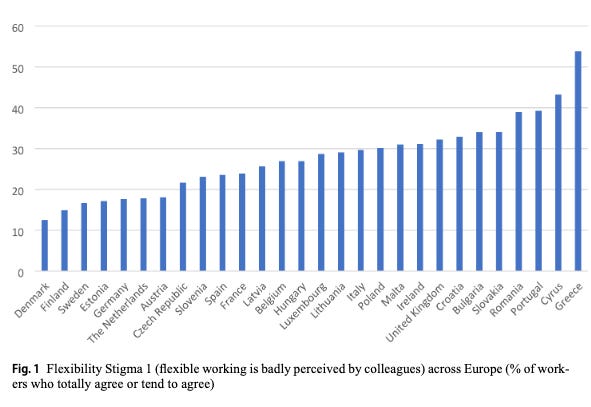
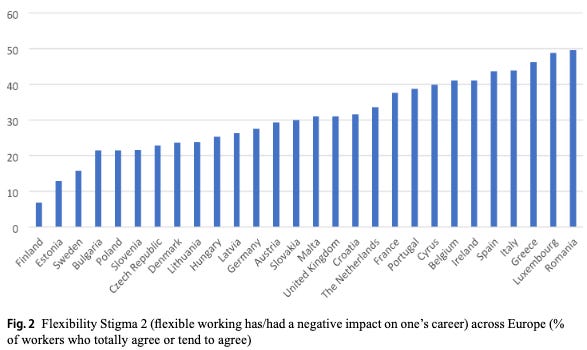
So in simple terms, these tables show that where you live (policy, culture) can influence perceptions on flexible work – but not necessarily the negative career outcomes. As you’ll see below, unemployment was the better determinant of career outcomes.
The authors present a meaty table of “individual level characteristics” from the data. Here are the insights:
Women are more likely than men to think that flexible workers are viewed negatively in both types of stigma (perception and career progression).
Younger workers (15-34) are less likely to think that flexible working is viewed negatively.
The result pretty much flips when it comes to men and ages, where younger male workers are more likely than older age groups to think that flexible work has negative consequences on career progression.
Those who have a higher education are less likely to perceive stigma than workers employed in “manual occupations”.
Results varied across age groups of the first stigma (negative perception) but not the second (career progression).
Those with caretaking responsibilities are more likely to say that stigmas exist… which… well, yeah. The authors note that this is “largely driven by mothers” but here are some direct quotes:
“Mothers of very young children (< 3) and women with other care responsibilities are more likely to believe that colleagues hold negative views against flexible workers, compared to women without children or other care responsibilities.”
“Mothers with children between ages 7–14 and women with other care responsibilities are more likely to say that careers can be negatively impacted by flexible working than women without care responsibilities.”
“For men, fathers with children age under 3 are somewhat more likely to think flexibility stigma exists in terms of negative career outcomes, than those without care responsibilities, but the opposite was found for fathers with children between ages 7–14.”
The authors conclude on this point that it “confirms” the idea that those who have responsibilities outside of work – who have likely experienced the stigma firsthand – are more cautious.
Beyond the individual, the authors then share findings relating to their hunches (hypotheses) above about how the variables – i.e., the policies of where you live, union influence and labour market conditions – influence flexibility stigma.
They found:
Employees in countries with “ideal worker” norms and long-work hour cultures are more likely to say that flexible work is badly perceived by colleagues. Whereas, employees in countries with “egalitarian gender norms”, generous national family policies and broad childcare coverages, are less likely to think this way.
The authors found that gender and work culture norms seem to be “more robust” in explaining stigma, compared to the other “hunches” (variables) – however, they question whether this is because stigma is “influenced more by norms and cultures than institutions” BUT, they also offer a counter theory to that, in which they state, “cultural norms variables may be mediating the influence of the institutional variables on flexibility stigma.” ie, is it a norm because a policy did a good job in the first place?
Countries with higher union density/collective bargaining coverage are less likely to have negative flexible work perceptions.
Worth noting (direct quote); “The unemployment rate is the only significant factor explaining the cross-national variance in the perception of flexible working leading to negative career outcomes – namely, in countries with high unemployment rates, respondents are more likely to say that flexible working leads to negative career outcomes.”
In wrapping up their paper, the authors state that their results support the idea that “cultural norms matter” and are “perhaps some of the most important factors explaining the levels of flexibility stigma perceived in a country” – most specifically, cultural norms around “long work hours”, the “ideal worker” norm and “traditional gender norms”. But the good news from their study is that national-level interventions can, as they share, “tackle this.”
“Ensuring a more family-friendly policy environment through the introduction of more generous family policies such as public childcare services can help tackle flexibility stigma… Providing generous family policies at the national-level can help change norms around work-life balance, where rather than being a work-centric society, a good work-life balance becomes a norm for all workers, and make gender norms become more egalitarian. In such scenarios, biased views against flexible working are likely to be reduced. Similarly, providing workers with more bargaining power, whether it be through stronger union bargaining power or due to shifts in labour market conditions being preferable, could potentially shift work and gender norms, which helps workers feel less stigmatised when taking up FWAs.”
So, what should we take from this?
Firstly, a strong reminder that stigmas are not naturally occurring mystical ideas. They are created. CURATED. And therefore they can be uncreated. Or rather, dismantled. This paper suggests that we need to stop thinking that national-level policy and culture around work “devotion” doesn’t then translate to the weird AF micro-aggressions people (mothers) experience when they try to use flexible working options. Just because we’ve been led to believe that the state and workplaces are separate entities doesn’t mean they’re not influencing one another.
It would appear that laws/policies around work hours/work devotion actually might have a positive impact on shifting people’s attitudes to accepting flexible work. Our minds immediately go to the mythical Nordic states, but I also think very quickly too of France, knowing the laws they have in place, for example, on when you can and can’t contact an employee and more generally around the number of working hours.
Now, perhaps it’s because I’ve (nearly) always worked in the private sector, but as I mentioned earlier, I find the union/collective bargaining power finding here really fascinating because it’s such an uncommon feature in said sector. But the more I think about it, the more it seems pretty damn obvious that collective “bargaining coverage” on employee work topics could ultimately have a positive influence on stigma because it means a group is taking a shared position on it. Do working mothers need a union? I mean, listen, MAYBE!? I’ll call my little brother doing a PhD on Political Philosophy, and let you know, lol.
Given Emma’s working-class background, would she join it!? Who knows.
The last point I want to make here is the insight into the influence of unemployment. It sounds so obvious once you read it: higher unemployment = less employee bargaining power on flexible work – but man, when it sinks in, it’s a little terrifying given the nature of employment we’re entering, where, especially in the private sectors, humans are being seen as computer trainers and somewhat easily replaceable by the pool of highly talented people regularly being made redundant.
Because in this world, mothers needing flexible work are going to have the very least bargaining power, and I mean, seriously? We deserve better.
Anyway, folks, wow, that was a deep dive. I hope in the very least, when you hear remarks like what Emma Grede made, you can think about the stigma in a very mechanical way ie; it is a made-up perception to the benefit of workplaces, and we can unmake it up too. (IDEAS)
If you made it this far, I’d love to know what you find most interesting about this paper?
With care,
Kiya
Thank you for reading! Subscribers of Promoted to Mother receive 1-2 essays each week on motherhood and the work we do – paid, unpaid and the internal work too. My essays blend personal experiences, interviews and my PhD research on the topics.
If you’d like to support that work, you can choose a paid subscription for $5 a month, or leave a coffee tip here. Paid subscribers receive research deep dives on motherhood and work, along with quarterly resources.
I feel like my situation is slightly different as I'm freelance, but I can hand on heart tell you that I never got as much work done in an office as I do now. I find it so weird that the accepted thinking is that people get more work done in-house. I literally used to book out meeting rooms for me and my work friends so we could have a 15 minute chat between clients. My cat doesn't have the same kind of chat, so when I'm at home working, I work
The stigma *is* the same when you say you're freelance and working from home though. I swear everyone on the school run thinks I don't actually work. It seems to be really hard for people to wrap their head around me planning my work around my kids, I have had so many conversations in which I can see people losing interest in my response to "what do you do for work" because they're clearly thinking "Oh OK, she doesn't really work." I DO! I DO WORK! I SWEAR IT! I AM ACTUALLY VERY, VERY PRODUCTIVE!
The connection between our work culture and stigma is so interesting! I never thought of it this way before and yet, it’s such a huge part of why mothers in the US go back to work and outsource care. This makes me think about the flexibility I would need in order to return to paid work, it’s also interesting how flexibility isn’t something you can really ask for in a job interview and if someone promises you flexibility, their definition is likely very different from yours.
This was brilliant and YOU are brilliant! 👏👏👏